
Thanks to early pre-ordering, it seems like planner season is getting longer and longer each year. For those who are struggling to feel at peace with their planner systems, this also means more time for anxiety about what planners to get in the coming year!
In this post I’ve outlined a process that has been helpful for me, as well as tips and resources from other planner nerds in the community that might help with your decision making.
1. Start with a needs brainstorm
The thing about the is wonderful community is that it’s full of awesome ideas and creative people who share their planner spreads and make us want what they have. On top of that, some planner companies are just really freaking excellent at generating excitement and buzz about their products.
It’s fun and can literally be an adrenaline rush to get swept up in the whirlwind of planner drops and pre-orders, but if we let these forces LEAD our planner decisions, what happens is we create a dynamic where we’re trying to integrate our lives into a desired planner system, as opposed to making a planner system work to make our lives better.
So the first thing I (and some of the very smart planner YouTubers below) recommend to anyone who isn’t sure about their planner lineup, is to start the process with a list of what you need. I recommend doing this as a brainstorm; don’t analyze anything yet (that will come later)—just turn to a blank page in your planner/notebook and make a list of anything and everything you think you might want to do with your planner system.
Include things you already do, things you’re not sure of, things you’ve seen and want to try, all of it. Some examples:
- To do list management
- Health tracking (exercise, steps, sleep, weight, mood, etc.)
- Scheduling
- Time tracking
- Project management
- Note taking
- Commonplace
- Reading log
- Memory keeping
- Anything else you might want to do
2. Audit and prioritize
Now with all of the potential things you want to do with your planner down on paper, take a look at the list and do the following:
- Scan the list of anything you already have tried and you know works well. By works well, I mean it’s an aspect of your planning that brings you joy, that you do consistently, and you feel enhances your life and you know you definitely want to carry into future planner systems in some way shape or form (doesn’t have to be exactly how you do it now). Circle them.
- Now scan the list for things that you know you definitely want to figure out even if you’ve yet to find a good way to work them into your system. These could be areas of your life that feel chaotic and want a planning solution to help bring some order. What these are, are things where in day to day life you wish you had; what they aren’t, are planner functions you think could be cool even though you would never think about them if it weren’t for inspiration from someone else. Underline them.
- Next, go through the remaining list and look for the things you really just want to try because they seem cool or fun or like they might be the thing you never knew you needed but could possibly really like. Select no more than 2-3 of them, and put a star next to them. It can help to think of these as experiments you’re going to try, rather than things you’re committing to do. More on that later!
- And finally, take anything you really wanted to star and struggled to cut for the final 2-3 and put a question mark next to those.
You should now be left with a prioritized list of planner needs, including things you want to preserve (circled), things you need to invest time into figuring out (underlined), and a list of things you can experiment with, starting with a few you want to try first (stars). You can/should of course continue tweaking this, but consider it the wishlist you can refer back to whenever you feel the pull of planner FOMO and can decide whether you should resist temptation.
3. Assess your options
This is the time intensive part of this process. On a separate page (preferably one that you can view at the same time as your current one, so not the back of the paper), make a list of the planners you’re considering, including a row for every single section for each, e.g. monthly pages, vertical weekly pages, daily pages, etc., like so:
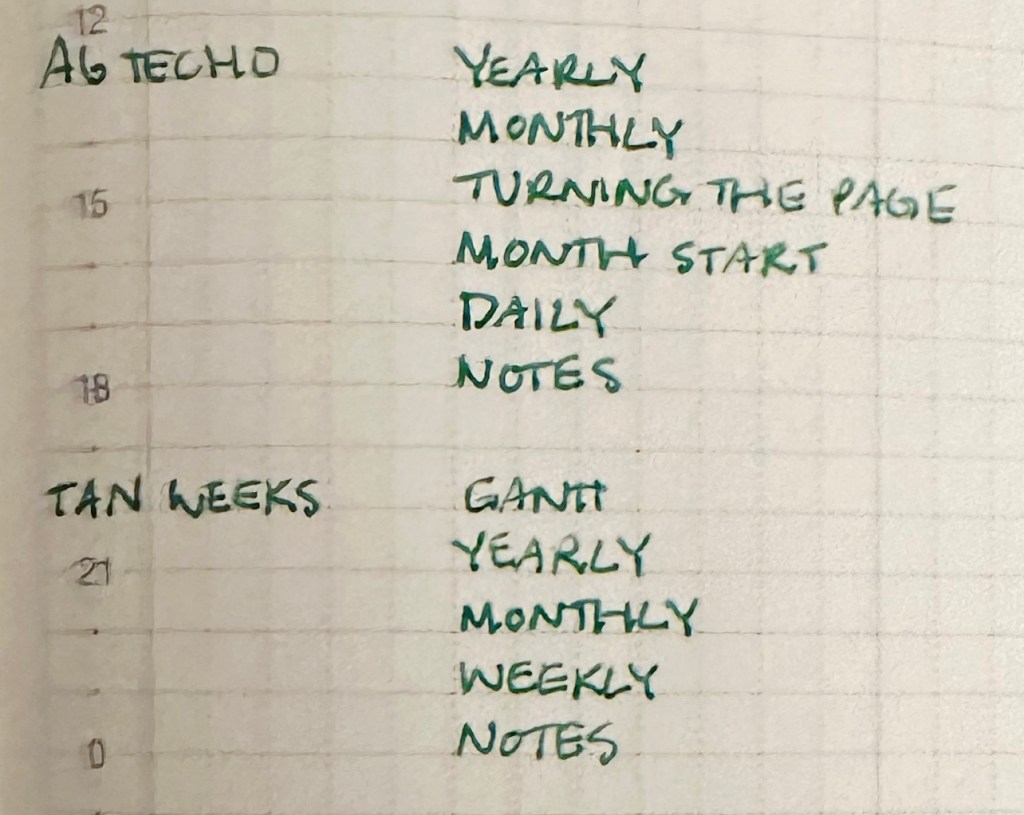
Go back to your prioritized wishlist and for each thing you know you want to do, scan through the list of layouts on the right and identify planner layouts that could work great for it. As you see potential matches, write the use case next to the corresponding planner page. You may find more than one thing will match with the same pages, that’s ok. (Note: if you need inspiration, see ideas here or from some of my favorite creators).
When you’re finished with that, look at the planner list and see if some answers begin jumping out at you. Don’t be afraid to cross things out and to recreate the list as many times as you need as you think through it. This is a visual thinking exercise in scrap paper. You may find that one books would be great for multiple purposes, which could mean you need two instances of that book.
As you work through the list, here are some considerations you might want to keep in the back of your mind.
4. Do some test runs
As your list starts shaping up and you develop hunches for what planner layouts could work, you don’t have to wait until December or January and hope for the best. I recommend you start trying them out right now! Here are some options:
- Most planner companies have either printable versions of their layouts available or share photos of them. Some Etsy sellers also recreate them and sell them as digital downloads. You can print the spreads out on loose paper and try them for a few weeks or months to see if you like them.
- You can also recreate the spreads yourself in a blank notebook.
- Yoseka Stationery has recently release a very fun project called Yoseka Lab, a booklet with 2 months worth of planner spreads of all different kinds so you can try them all.
5. Embrace fluidity and make room for change and growth
A key part of edging closer to planner peace is to accept that planner peace is as much about the journey as it is about the destination. Although there might be some unicorn planner nerds out there who have a fixed system that has works for many years and will never changed, they are rare if they’re not total urban myths.
In my opinion, planner peace is just being happy. You can be happy while you experiment, and you can be happy even if your planner system changes multiple times a year. Of course, you can ALSO be stressed out by planning, which is really what this process is trying to help you avoid.
Planners should be a tool to make your life better, whether they function to bring order to chaos, help you organize your thoughts and stay focused on your goals, or if they’re an escape where you can have alone time to create something beautiful. There is no right or wrong way to plan—just make sure your planner(s) serve you and not the other way around!
Lastly, try to resist pressure or guilt from other people about the way you want to use your system. There are lots of different types of people in the community and you may find there is subtle and overt, intentional and unintentional pressure about the number of planners you use, the kinds of accessories you have, the style of planning you enjoy, etc.
6. See similar processes in action
For further inspiration check out these YouTubers who use versions of this process:
 Ask a Planner Nerd