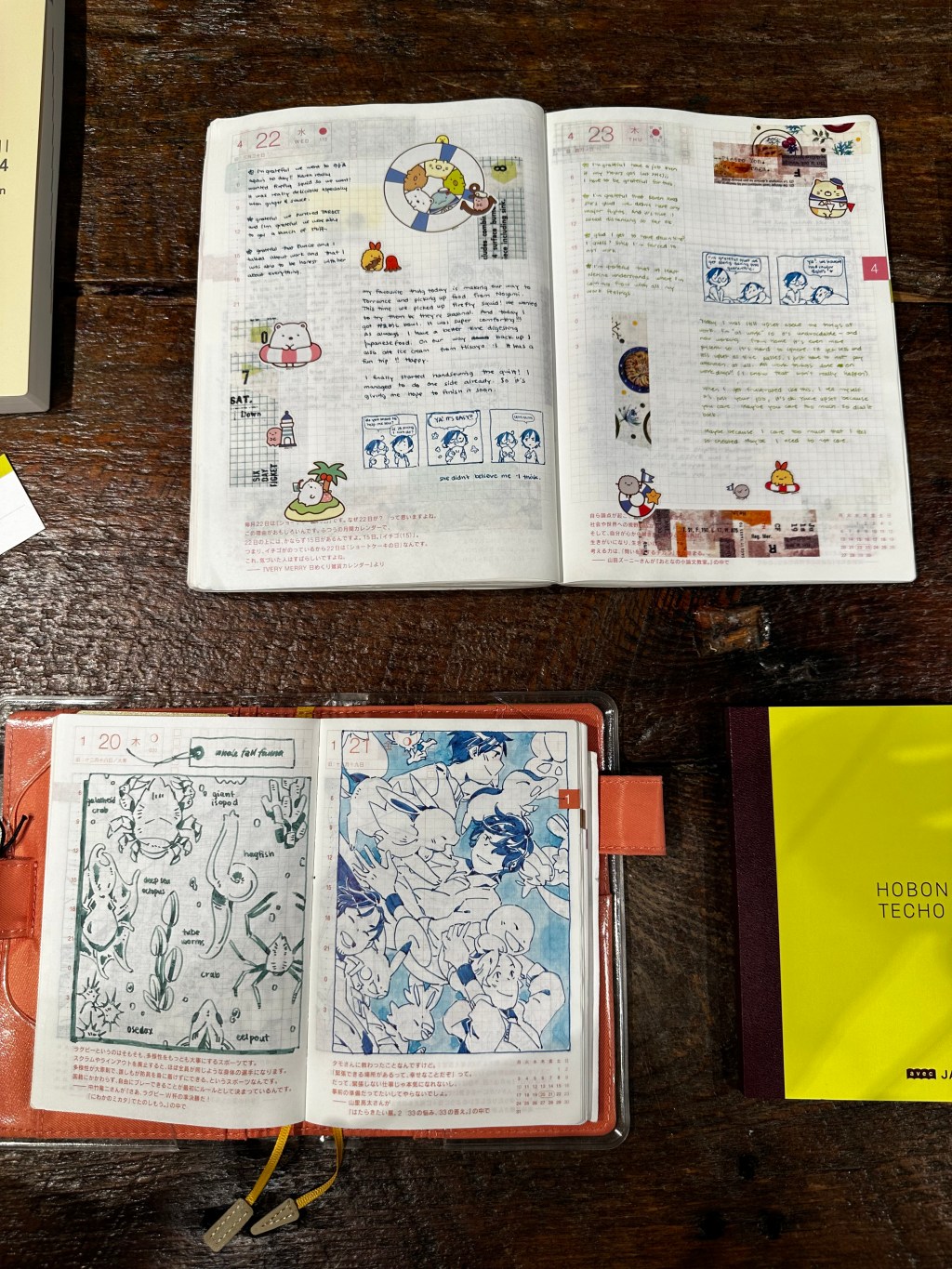
There is no right way to use a planner.
While the beautiful spreads people post online are tempting to replicate, they’re not always sustainable—especially if the style of planning used doesn’t match your lifestyle. It can also be difficult to find inspiration for the full spectrum of planning styles because some, like decorative planning or art journaling, tend to be more represented on social media.
Below is an list of the main planning and journaling styles, with examples, to help you figure out what yours may be:
Decorative or Maximalist Planning
Decorative or maximalist planning has higher representation on social media because by nature such spreads are like art projects and their creators want to show them to the world.
Decorative planners make heavy use of stickers and sticker kits, washi tapes, stamps, collaging, you name it. YouTube has an endless library of videos showing how decorative planners set up their planners each week or each month. The decorative planner community drives the micro economy around sticker kits and subscriptions, many of which are created by individual artists. Popular ones include The Coffee Monsterz Co. (TCMC), which features cute illustrations, and Sterling Ink (SI), maker of the Common Planner, which specializes in floral designs.
Preparing a planner can be a real event for decorative planners, many who choose to create themed designs each week or each month, make things like custom dashboards, add accessories such as page tabs to their planners. For decorative planners, these customizations are very much a part of the fun of planning.
Some examples:
Functional or Minimalist Planning
On the other end of the spectrum are functional or minimalist planners, who may or may mot use stickers and other decorative elements but mostly focus on utility in their planner layouts. Functional planners may be more excited by new ways to visually track daily activities than by the aesthetics of their spreads. (In case you’re wondering, this style is me.)
This is not to say minimalist planners don’t have aesthetic spreads—many such spreads are actually very beautiful in their functionality. But they’re minimal, so they tend to be more ink and text based than their maximalist counterparts. In contrast some planners call themselves “messy planners” to further differentiate a segment of functional planners who do not care whatsoever about how their spreads look, and essentially treat their planners like disposable tools.
Some examples:
Bullet Journal or DIY Planners
Bullet journalers follow a method created by Ryder Carroll, which has spawned all kinds of creative DIY spreads. My observation is that bujo planners tend to have a lot of overlap with functional planners, but the beauty of bullet journaling is people who do it create their own planner layouts from scratch and can change it up anytime they want to. Bullet journaling can be done in any blank notebook, but dotted paper is commonly the preferred type.
There was a time when Bujo was massively popular, and while it still is common, it seems people eventually get burnt out from having the create their own spreads over and over again for years on end. Still, many people (myself included) continue to borrow heavily from the trackers and other spreads popularized by bujo, even if they’re not bullet journaling anymore.
Some examples:
Journaling and art journaling
There is a vibrant community of people who don’t use planners for planning at all, but rather to journal or art journal. Folks who do this will use dated books to write, draw, paint or collage on one page or section of a page each day. People who use planners in this way often proudly show off their work and grow their books substantially with all the mediums they use on the pages.
Some examples:
 Ask a Planner Nerd