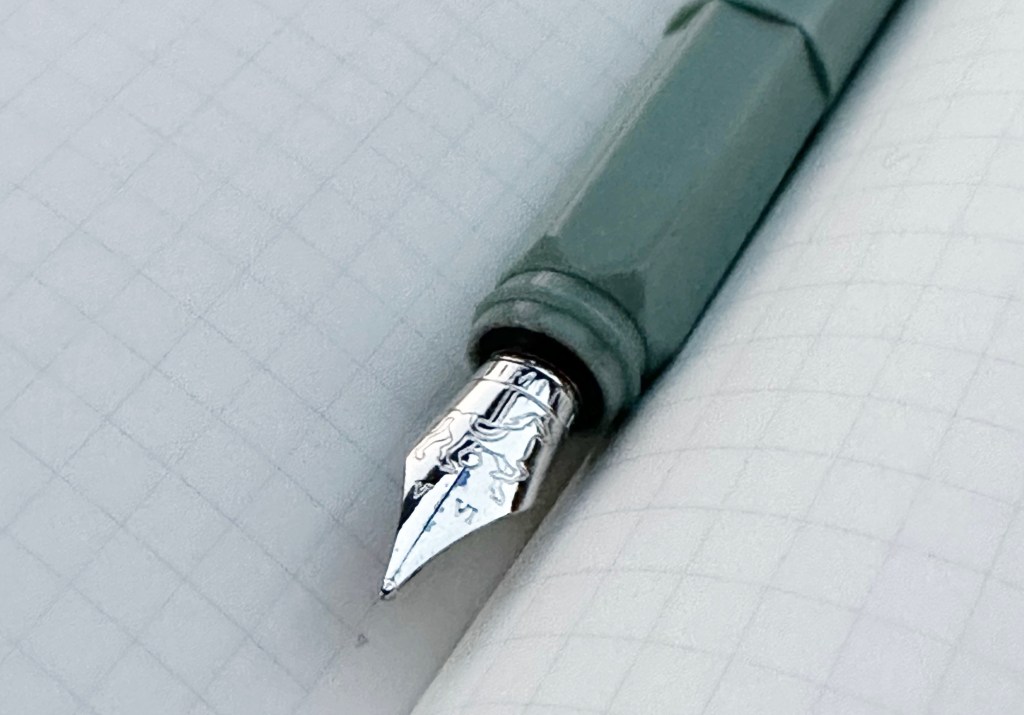
There are tons of resources on the internet for beginner fountain pen users but for curious friends, I struggle to find something simple, easy, and thorough. So I’m making one! I’ve included tips and links and videos by others. Hope it helps.
See also my post on the benefits of fountain pens.
If you’re on a budget or really aren’t sure if you want to be a fountain pen user yet
Try any of these pens: Platinum Preppy, Pilot Kakuno
For ink: use the included cartridges
For paper: these starter pens have fine nibs so you’ll be ok writing on most paper. Worth mentioning that most non-fountain pen friendly paper is absorbent, so ink won’t appear in its ideal form out of your pen. It may “feather,” with lines appearing thicker.
Notes:
- With these pens you’ll get a taste of what it’s like to write with a pen where ink flows through a nib and little pressure is needed, but not much more.
- To try something with more flair, you can also try a Pilot Parallel, which comes in a wide variety of widths so you can experiment with calligraphy and line variation. They are also inexpensive and come with cartridges.
- These pens come with basic instructions so you probably don’t need tutorials to get started.
If you know you want to use fountain pens and can spend more, but don’t know where to start
Pens to try: Sailor Tuzu, TWSBI Eco, TWSBI Swipe, Pilot Metropolitan, LAMY Vista or Safari
For ink: Purchase sample size inks from retailers that offer it, such as Goulet Pens or Yoseka. They are inexpensive so you won’t need to commit yourself to a large bottle until you know for sure what you like.
For paper: Since you’re spending a bit more on pens and hopefully trying different line widths and inks, paper will matter more. Most fountain pen retailers sell fountain pen friendly paper. They all have different properties with different benefits but as a beginner, don’t worry too much about this yet. Just know that ink will look different on different paper, and you will eventually any to experiment with them. Some retailers, like Goulet Pens, sell paper sampler packages so you can try a bunch. My favorite is Tomoe River paper.
Notes:
- Consider getting two, one with a fine or extra fine nib and one with a broad or stub nib. These are opposite extremes you can experience as you discover your own preferences. (You may surprise yourself.)
- Consider also getting two different filling mechanisms, or methods of refilling the pens with ink (my recommendations include a variety).
- Even if you think you will only ever like plain black or blue ink, get at least one ink that looks weird/special. There will always be black and blue ink options, but the only way to experience the difference of fountain pens is to try them in their most glorious state. One iconic ink to try if you’re unsure: Herbin Emerald of Chivor.
- When first starting out, don’t put very shimmery inks into finer nib pens. As you gain more experience you’ll find it’s often ok, but you’ll be frustrated if you accidentally clog the only 1-2 pens you have.
Good tutorials that will help:
If you’re comfortable spending a little bit more than the above
What to get: TWSBI Diamond, Mini, or one of their Vac fillers, LAMY Studio
For ink: Same as previous category
For paper: same as previous category
Notes:
- I don’t really recommend starting with any of these if you can only afford one of them, though I have given these as a gift to new users. I think the best advice for beginners is to experiment, so IMO getting two pens from the previous category would be a better use of funds than getting one from this category. Any of these pens would be excellent daily workhorse pens after you decide on your personal preferences.
- If you’re unconcerned about budget, these are solid pens you will likely continue to use after you gain more experience, so you’d do well with them. What sets them apart from the previous category is mainly their superior build quality.
- With this category I also introduce an additional filling mechanism: vacuum fillers. The TWSBI Vac-700 or VAC mini and other such pens can be very fun to use if you want to dive right into something with cool engineering. Here’s how:
If you’re not concerned with money
Try whatever looks the best to you out of these consistently high quality and low maintenance pens: Pilot Custom 74, Platinum 3776, any BENU pen, any Opus 88 pen
For ink: Since this is the “money is no object” category you could just trust me and go ahead and get a few bottles I recommend that offer some variety. Herbin Perle Noir for a very solid black ink choice that’s always good to have around, the aforementioned Herbin Emerald of Chivor for a well behave yet extremely fascinating teal ink with shimmer and sheening properties, and Sailor Manyo Haha so you can try an (also iconic) multi-shading ink.
For paper: same as above
Notes:
- These are all reliable pens you couldn’t go wrong with, however I don’t actually recommend them for true beginners. Even if money doesn’t matter to you, this price point enters a territory that feels wasteful to spend for experimentation. For example, you may get a Platinjm 3776 in fine and realize immediately upon getting it that the line is way too thin for your liking, and never use it again. Personally I like ALL nib sizes so I never had an issue with this—but I know many people exclusively write with very fine or very broad pens.
- Opus 88 pens have yet an other type of filling mechanism. They are “eye dropper” pens, which are filled differently from the videos I linked above. They’re technically simpler, but their benefits are a bit more complex to explain; so in an effort to keep things simple I’ll only share what you need to know to start:
- If you get a light, shading ink like Manyo Haha, try it in a pen with a broader nib, like a Broad or Stub nib. Lighter inks are less legible in finer nibs, and it’s also harder to see their shading properties, so you may find that frustrating. More on inks properties here:
Lessons I’ve learned that inform my recommendation above
Fountain pen advice is subjective, I won’t pretend my perspective is “correct.” If you ever join an online fountain pen community, you’ll find many lovely people and also many differing perspectives. Without developing your own preferences and trying things out, it’ll be hard to know who to listen to. Below, I’ll share some lessons I learned so you can see where I’m coming from and the kind of consumer I am, so you can decide if you have similar tastes and habits. If you do, take my advice over others. If you don’t, feel free to disregard!
- I’m very glad I didn’t listen to the chorus of people on the Internet who aggressively insist that beginners should only buy cheap pens to start out with. There is nothing at all wrong with budget pens, especially if they’re all you can afford. And some of them (like the ones I recommended) are truly solid in their functionality. But if you can afford something a bit more premium, you’ll find more exciting designs, more interesting filling mechanisms, and more nib variation to make experiment with, starting with mid-tier pens. Personally I knew for sure I’d want to make fountain pens a part of my life BECAUSE of these pen features. So it made no sense to waste time and space buying starter pens.
- I have medium sized hands so I can use a wide range of pen sizes, but I discovered after using fountain pens for a while that I don’t like small, lightweight pens. The Kaweco Sport, which has a cult following, is a lower cost pen but it feels as cheap as it is, and the quality is inconsistent. When I finally shelled out for a Sailor (a prominent Japanese brand of pens known for their proprietary gold nibs that have pencil-like feedback), I purchased a Sailor Pro Gear Slim, which was smaller and lighter than the regular sized Pro Gear. I thought I was getting a deal, but I wasn’t—because I rarely use those pens. They frankly feel cheap in quality compared to the exact same models in bigger sizes.
- Pens are useless to me if they are high maintenance. By that, I mean I would have to write with them very frequently or clean them regularly to keep them flowing and prevent them from drying out. Many, many pens on the market dry out easily—I know this because I bought them! I now only purchase pens if I have authoritative information about their cap seals and their reliability. Tried and true brands with good quality control: Pilot, Platinum, Sailor, BENU, TWSBI.
- Amazing pens not mentioned because I don’t recommend them as anyone’s very first fountain pen: Pilot Falcon, Pilot 823, Pilot Custom 912, Sailor Pro Gear, Magna Carta Mag600, Pilot Vanishing Point or Decimo, Esterbrook Estie with custom nib grinds, Schon Dsgn Monoc nib pens, Franklin-Christoph custom grinds, other smaller pen makers
 Ask a Planner Nerd