If you’re in the analog planning community, you’ve probably seen people talk about fountain pens. And if you’re not already a fountain pen user, you may wonder why anyone would pay extra money to for these old school writing instruments when disposable pens are readily available, and do not require special paper, filling, refilling, and cleaning.
In this post I’ll attempt to answer this question, so you can figure out if this is a world you want to check out for yourself. But first, allow me to show you a wonderfully sensory video by Goulet Pen Company that is worth more than 10,000 words on the subject:
And if that wasn’t enough of an explanation, here are several reasons why people like to use fountain pens:
So many cool inks
Starting with the reason I personally love using fountain pens: no other writing instrument will enable you to carry around a vast variety of inks in every possible color, with all the different ink properties (shimmering, shading, sheening). You can get teal ink with red sheen, light blue ink that shades pink, green ink with gold shimmer, yellow ink that dries like popcorn butter on the page—the list goes on and on. Every new ink discovery is like a new adventure.
Customize your handwriting with line variation
Though you can do some cool lettering with brush pens and angled markers, fountain pens are the best writing instrument for long writing sessions that give you the ability to put some character in your penmanship. Different kinds of nibs let you write thinner lines, thicker lines, and a combination of both. When combined with your favorite ink, you can customize your writing in many more ways than you would if you could with any other kind of pen. And of course, you can always practice calligraphy!
Encouragement to write more
Many people find that investing in fountain pens, which require maintenance and choices in ink and paper, to be a much more intentional experience than picking up another type of pen. As a result, they feel motivated to write more, so they can put the fountain pens and stationery to use. Writing by hand has many benefits, with fountain pen users saying they commit things to memory differently when they write things down instead of typing them.
More comfortable than ballpoint pens
If you’re used to writing with ballpoint pens, you probably have to apply pressure to paper when writing to make the ink flow consistently. Gravity helps ink flow in fountain pens, making it unnecessary to use pressure, and many people find them more comfortable and pleasing to write with as a result.
Appreciation for design and engineering
There are different kinds of fountain pens to suit all different writing styles, and as such there are many different kinds of nibs, feeds, filling mechanisms, cap seals, and more, that help you achieve the exact experience you’re looking for. Some people like collecting them all. Some even like to make their own. And after all this time, even with this seemingly straight forward object with a relatively small following, pen makers will occasionally release something totally new to enthrall us.
A more luxurious writing experience
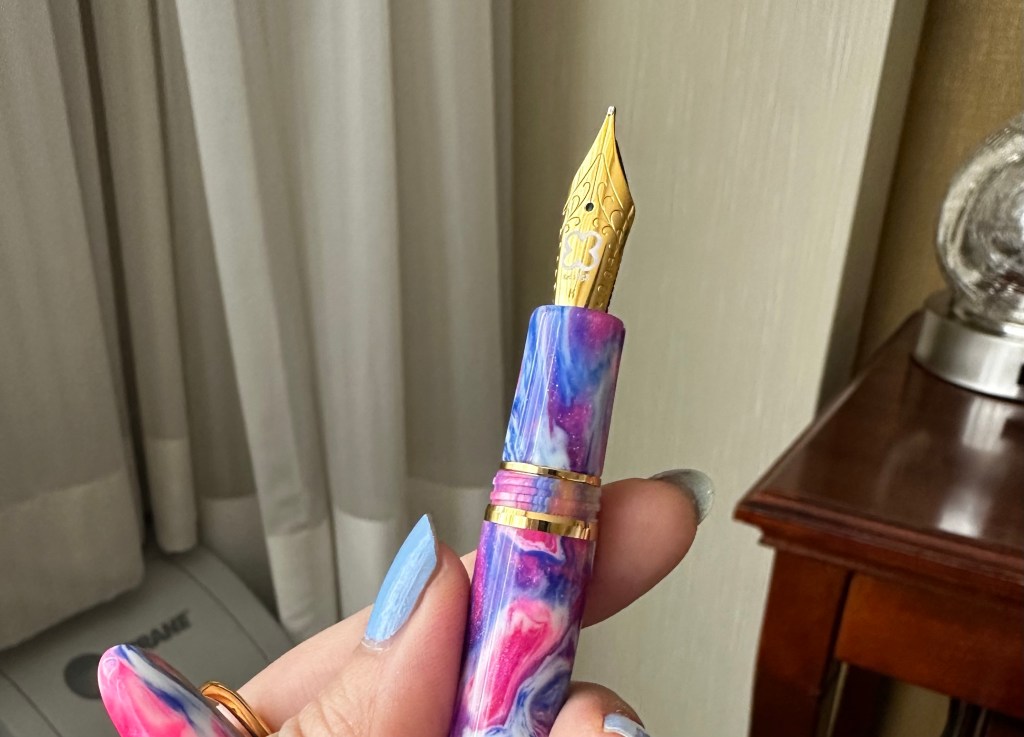
Fountain pen makers make some truly beautiful and creative pen bodies, sometimes using techniques that take months to complete. At the higher end, nibs are often made of precious metals. Function aside, picking up a pen made of gold, that is handmade by an artisan, or that is rare, appeals to many who enjoy indulging in the finer things.
Being part of a community
Fountain pen users come from all walks of life, but index high in hobbyists and creatives, among other commonalities. At the same time, the percentage of people who gravitate toward fountain pens is low enough that meeting a fellow user can be exciting. So it can be fun to connect with other fountain pen users online or in person at pen shows and other meetups. For a flavor of this, check out the Fountain Pen Network, listen to/watch the Goulet Pencast, or visit a fountain pen store like Yoseka Stationery where people will happily geek out with you over fountain pens no matter how much or little you know about them.
 Ask a Planner Nerd