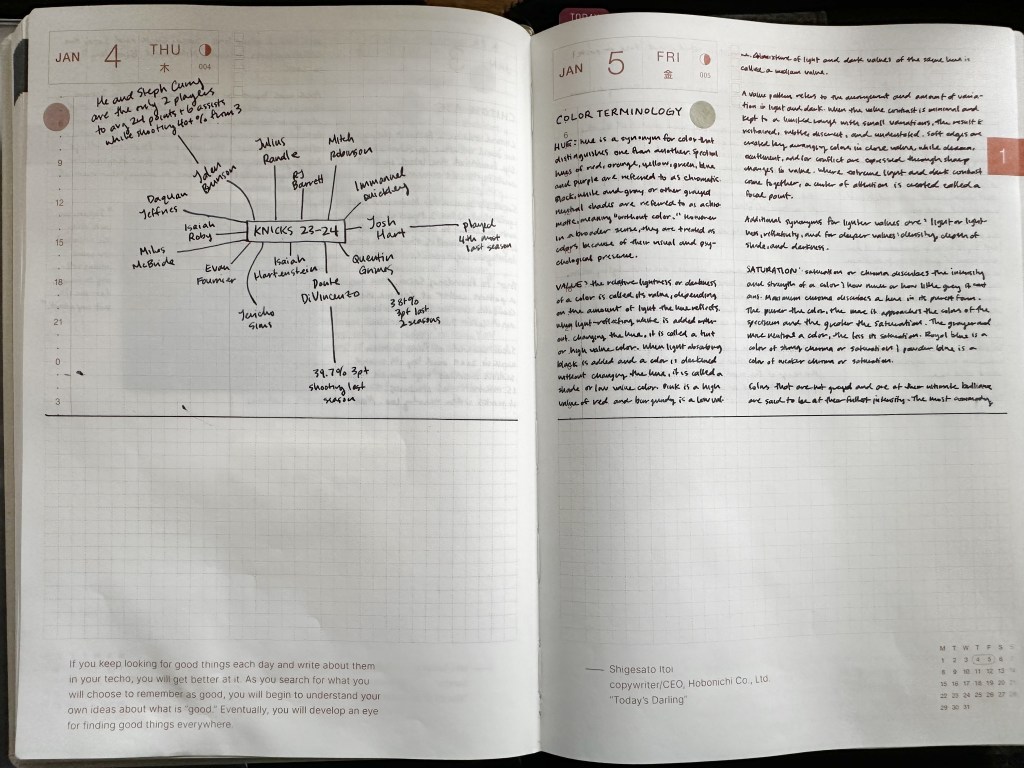
“[My life book is] an open space for me to enrich my mind and work through possibilities that excite me and make me happy to be alive.”
I’m a multi planner person, and the foundation of my system is a book that serves as an anchor for my life, that I often refer to as a “life book.”
My life book is scrap paper for my brain. I use it to sketch out ideas, draw charts and diagrams, make first drafts of things, keep lists of long-term projects I want to take on, take note of new things I learn, jot down random bits of knowledge I come across, and more. While messy, the book is an important artifact that represents the thoughts that make me who I am, as opposed to lists of things I do at work (my work planner), a log of things that happen to me (my 5Y memory keeper), emotions I process in long form free writing (my journals). It’s an open space for me to enrich my mind and work through possibilities that excite me and make me happy to be alive.
I recently shared a photo of it in the Facebook Hobonichi group and got some questions about how I use it, so sharing more details here in case it’s helpful for anyone else considering a book like this!
Which book do I use for my life book?
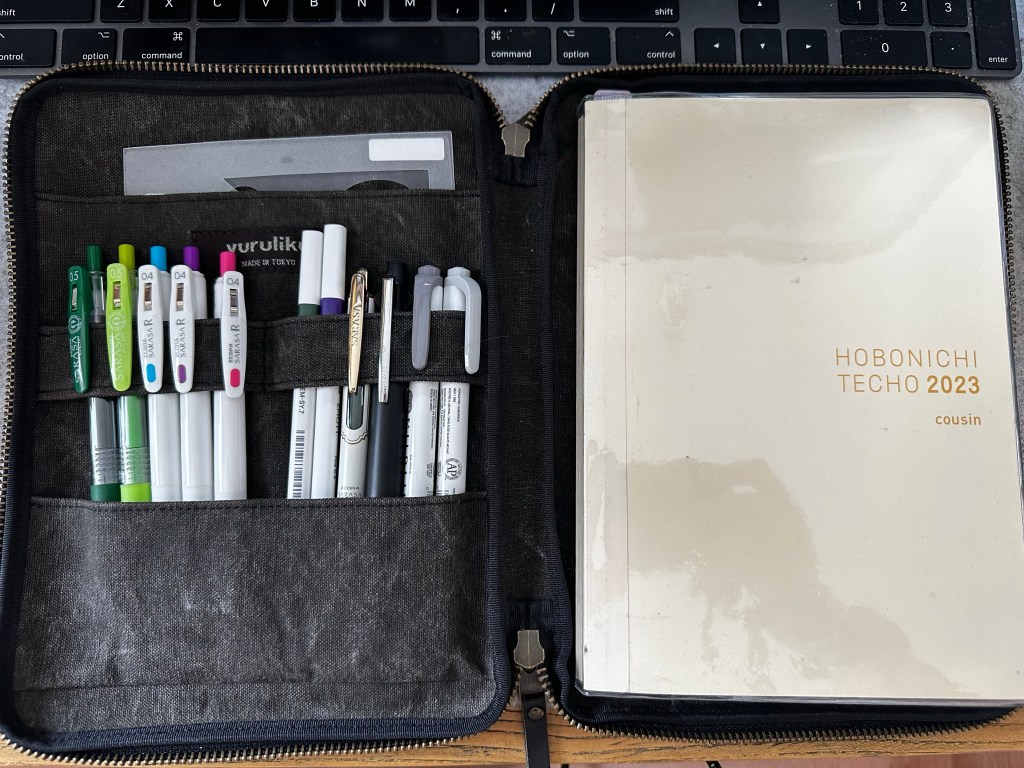
I’ve found the Hobonichi Cousin serves the purpose very well because it’s bound well with plenty of pages, isn’t totally (intimidatingly) blank, and has dates that can double as an index.
Alternatively I think any chunky bound book will do; I find lose paper in binders don’t archive well and while I love a thin book for other purposes I want my life book to feel as substantial as it’s contents. Alternatives include Stalogy 365 (if you don’t mind a blank canvas) and Sterling Ink’s full year Common Planner, which has dated sections and many blank (but numbered) pages.
How do I index the contents of my life book?
Each time I finish writing in the daily pages of my Hobonichi Cousin, I flip back to the perpetual calendar at the beginning of the book and wrote down the topic I covered on the corresponding day. In the past I’ve also used highlighters to color code the topics, so for example if I code anything related to money and investing as green, I mark the entry with a green highlighter and anytime I need to find an old entry my eye goes straight to the dates/pages within the right category.
An idea inspired by Megan Rhiannon was to use dot stickers to color code the pages themselves. I keep space open at the start of the book for an index, and as I use pages I either add new categories to the index or if I’m returning to a topic I’ve already written about I add the corresponding dot color to the page. Stalogy dot stickers are great for this, and come in all different sizes and colors, but there are lots of cheap options on Amazon as well. Drawing circles with markers also can do the trick.
One thing to note is I really love watching my index grow because it is itself an expression if the very wide ranging interests that make me me.
What do I do about dated stuff?
The only issue with using dates as an indexing system for a book like this, is that while the majority of what I write down isn’t time bound, occasionally I DO want to work on a page with a correlated date. For all the time I’ve been doing this, I just lived with this problem because it wasn’t frustrating enough to fix.
I’ve recently begun testing a new solution, also inspired by Megan, which is a minor change but makes a huge difference, however!
I now divide the pages up and save a portion (a third or a little more) of them for day-of use and proceed to use the rest of the pages as I already do. This way, I can use the daily pages with reckless abandon—not a care in the world as to whether I might need the page for something that happens on that day later—and if something ever happens on a specific day where I want to write about it on exactly that day in my life book, I have some space to do so.
The freedom I feel from this small adjustment is blissful.
What do I do with the monthly pages?
My use for the monthly pages change every few months, but for the last two I’ve started to just log my media consumption in those pages and I’m enjoying that. I just write into the center of the box what I read, watched, or listened to that day, if anything. It’s convenient to have the reference to jog my memory. And I realized “when did you see/read that?” is a question that comes up in conversation more than I realized.
The secondary benefit is using the monthly pages this way, is if something I consumed has a more produced effect on me on any given day, it’s likely to be the thing I want to write on that daily page. So if I ever wanted to look back on my notes from a specific article or show, I can easily flip through my monthly pages and figure out which day I may have written my thoughts down.
Note: I don’t review things in this book. I sometimes want to review things and I just do that in a dedicated notebook, but mostly I find that HAVING to review every single thing I consume feels like a chore. Instead I like to just react, whether that’s through writing notes on my feelings or creating art.
What do I do with the blank page at the start of each month?
I work in a role where I have a mountain of tasks to complete every day and also manage a team that does a lot. So I have separate planners for work that are purely functional for project management and daily or weekly to do lists.
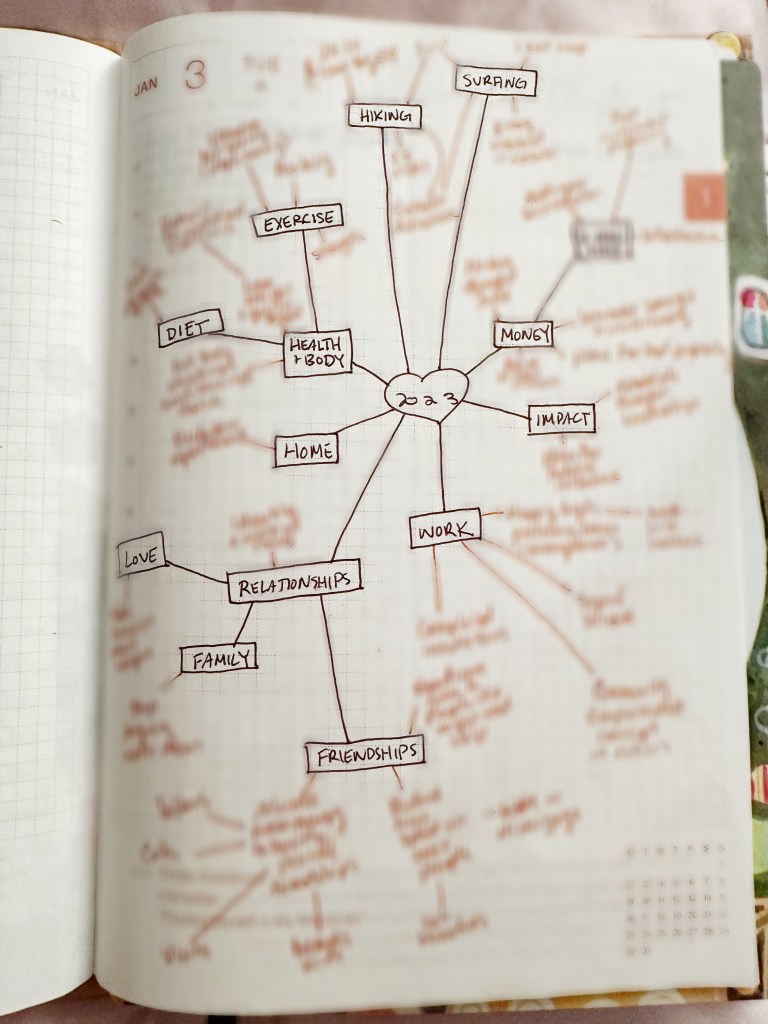
But I need to also pull up and see the big picture, not just for work but for my whole life (this is a life book after all). So I start each month with a mind map that includes the big ongoing projects I have for work and high level objectives in each, but also things I need to do to take care of myself and my personal life, family stuff etc. This mind map then serves as a visualization of the key things I’m trying to accomplish for the month, if I ever feel lost or off track.
Note: I also have annual Gantt charts and lifetime mind maps that get refreshed less frequently and inform the progress I try to make on a monthly and quarterly basis, for the BIG big picture. I often like to redraw those somewhere in my life book as well, so I always have them with me.
I also save the first page of every month for highlights and lessons, so I can jot down one line about the most memorable days throughout the month for easy reference when I look back. I write about the details if what actually happened in my 5Y journal, though, not in my Cousin.
What do I do with the weekly pages?
A lot of my life issues are centered around time management. If I don’t pay attention, time gets away from me and I feel like I’ve lost control of my life. While I don’t schedule on paper (collaborative digital calendars just have too many functions paper cannot provide), I do find that some forward planning can help me ensure I’m being intentional about how I spend my time and energy, and protect things that I want to do from getting bulldozed by work that always feels more urgent.
So in the weekly pages of my Cousin, I draw dotted lines across for when I ideally want to sleep, wake up, go to work, and end work. I block off time I anticipate using for family, creativity, exercise, friends, etc. This helps me identify when I might not have time for something I need to do, and forces me to MAKE time for it, perhaps by waking up earlier one day or postponing something that can wait.
With dotted lines drawn in, I then use a highlighter in the margins of the columns to track, by category, what I’m ACTUALLY doing with my time. At the end of the week I can see how waking up late throws off my exercise plans or working too late causes me to lose time for other things. I am often consistent with this practice but during very busy work periods I pause because I have no time (lol) and also because it can be a depressing reinforcement of what I already know is happening, which is that work hijacked my entire life that week.
What do I do with the “Turning the page..” blank spread at the beginning of the year?
Every year, I use these pages to summarize the previous year’s highs and lows and set an intention or theme for the coming year. This usually takes up about a page and a half, and then I use the remaining half page to print some vision board type inspiration of things that motivate me to accomplish what I’m setting out to do. For 2023, my mini vision board included a photo of a place I was planning to go for my 40th birthday, a photo of J Lo pumping iron, and a photo of a woman surfer ripping it.
What do I do with the blank pages in the back?
There is a handful of blank grid paper in the back of the Hobonichi Cousin—not nearly enough to use for notes. So what I do at the start of each year is write in what I call “mean affirmations.”
My issue is, encouraging “you can do it” and “live laugh love” type statements do not help me at all. I need tough love, and I need to call myself out on my bullshit.
So knowing exactly the tendencies I have to talk myself out of exercise or socializing, or overworking, ir never sleeping on time, I write in this section in big bold fonts all the things I would say to myself if I were a well-intentioned drill sergeant spitting hard truths and shooting down excuses. I find this much more inspiring than encouragement, but that’s just me!
 Ask a Planner Nerd